
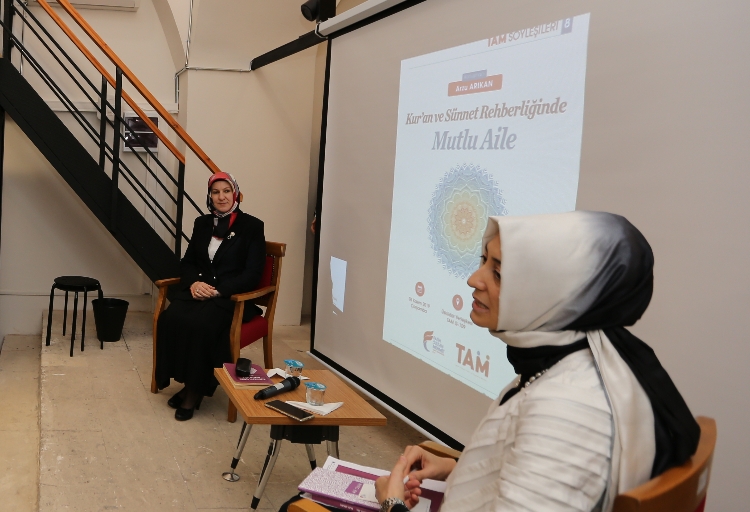
This is the transcribed text of the interview titled "Happy Family Under the Guidance of the Quran and Sunnah", which we held with Arzu Arıkan on November 6, 2019.
Zeynep K. Şerefoğlu Danış: Dear friends, dear guests, welcome to all of you. As you know, there are many events this week within the framework of Mevlid-i Nebi; As the Social Research Center, we wanted to center the family within the framework of the Quran and Sunnah, which are always on our agenda, but which we always talk about, but on this occasion we want to remember once again with consultation. We took our proposal to Ms. Arzu because she has a book specifically on this subject and she continues her studies in this direction both academically and in an NGO that takes responsibility. Thank goodness he didn't break it, he came himself. Thank you very much.
Arzu Arikan: I want to thank our teacher; I'm truly honored. In fact, our teacher made us hurry and I wanted to respond immediately, we wanted to accept the invitation. We should not delay good deeds. I hope it will be beneficial. I hope it will be a fruitful and fruitful conversation.
I am Arzu Arıkan, I was born in 1975. I was born in a Circassian village in Kayseri, as the youngest child of a farmer family with 6 children. I completed primary school in my village; Then, I had the chance to complete my memorization training at Beşiktaş Girls' Quran Course, alhamdulillah. Afterwards, I taught as an honorary teacher in some Quran courses. Later, in 1995, I was accepted to Erciyes University, Faculty of Theology. I graduated with honors in four years. It was a chapter I read with pleasure. Anyway, all my preferences from beginning to end were theology. God blessed me. I remember a writer right now: If a person does what he loves, he is never tired in the world; I am one of those who feel that way. My job has both a worldly and an afterlife aspect. I always thank my Lord for this. We are among the victims of February 28. I graduated in 1999. While we were thinking of pursuing an academic career at that time, unfortunately, we unintentionally stayed away from academic life during that period. Of course, we did not remain idle again; We constantly gave lessons in different fields and NGOs in our own field, in order not to feel that blame. Later, I got married and now I have a 16-year-old son named Yunus Hamza and a 12-year-old daughter named Zeynep Denef. They both go to Imam-Hatib; They kiss your hands. After the children grew up, that sadness in me never went away. I wanted to start academic life again. In 2013, I entered the master's degree at Istanbul University, Faculty of Theology. I had a motivation for my thesis there: let me work on something that would benefit society. I wanted to do what I worked for as charity. We compiled the study into a book titled "Happy Family According to the Quran". God willing, the 2nd edition is about to be prepared. As of this year, I have started my doctoral studies in the field of exegesis at Marmara University. I work in the education department of an NGO. I guess that's enough, sir.
Zeynep Kevser Şerefoğlu Danış: Thank you. In fact, we sometimes collaborate with Ms. Arzu in various projects; His energy and discipline really motivate me, too. While consulting, Ms. Arzu said that she wanted to start this week with a film shot by the Presidency of Religious Affairs. I liked the movie too. If you allow, we would like to start by watching it for a few minutes.
Arzu Arikan: Thank you sir, since I am actually a commentator, I thought of starting with the Quran and continuing with the examples from the Sunnah in the second part; If you see fit, I would like to start that way.
Praise be to Allah, who created the first human being with his family, prayers and peace to the Prophet Muhammad who exhibited an exemplary family life. Let's start our conversation by saying kudos to the Prophet and his followers who try to embody his example in their own lives. Now, of course, I have read a lot about the meaning of the word family, but I would like to start by sharing with you the meaning that I like the most. “"Family is more than one element that depends on each other, trusts, supports each other, and when you remove one of them, the others cannot survive." I really liked this because it expressed solidarity to me. I wanted to start my talk with this. I do not want to go into cliché sentences such as family is the foundation of society, it is the mirror of society, but I would like to say this and then move on to the main topic. Humanity has been experiencing a process called modernization for a long time. Some progress may have been made in the name of freedom in this process, but unfortunately there is corruption in the field of values and morality. Even considering the current increase in divorce, I will be expressing more or less what I am trying to say. We live in a consumer society, constant consumption, consumption, consumption! As a result, we encounter individualization, loneliness, and as a result of this loneliness, unfortunately, people become disconnected from their families and become unhappy. Spiritual dissatisfaction can cause other problems. When we look back at the Quran, yes, we will talk about a happy family today, but when we really ask what the source of happiness is, we can easily see that it is family. As you all know, there is the 21st verse of the Surah Ar-Rum. It is one of the verses of Allah Almighty; what is it? “It is among the signs of Allah that He created spouses from your own kind and placed blessing and mercy between you.” It is in the form. Compassion and mercy are two very important concepts. Dear elders and dear students, compassion and mercy are two concepts that we can consider as spiritual mortar. Since we will go into more detail about these two concepts later, I would like to go over them for now.
When we look at the Holy Quran regarding the importance of family, we see that there are more than two hundred verses; that is, directly or indirectly. The fact that there are more than two hundred verses in the Quran on many issues such as alimony, inheritance, wet nursing, from marriage to divorce, can be mentioned as an indication of how much importance Islam attaches to the institution of family. In Surah Rahman, verse 46: “"There are double heavens for those who truly fear Allah." It is commanded. Commentators make the following interpretation: I really liked it when I first read it. One of them is the heaven we call eternity, where we want to go after we die, but when we ask what the other heaven is, they say that it is the happy family branches in this world. Let's hope that God will make our home a branch of heaven for all of us.
We are currently talking about an institution that has existed since the first man, but hasn't it experienced some difficulties throughout history? More precisely, some efforts have even been made to liquidate the family institution. Very interesting, in China in the 1940s “Commune Program” and again more recently in the Soviet Union “Kolkhoz Project” Within this framework, the family institution was tried to be destroyed. People were led to have random sexual relations, babies were given to any woman when they were born, mothers were separated from their children, and even husbands and wives were tried to be separated from each other. But when you declare war on nature, you will be the loser. Therefore, eventually, mothers began to search for their children and spouses began to search for each other, in other words, secret negotiations began to restore family unity and integrity. After the program was implemented for twelve years in China and three years in Russia, the principle that family is the foundation of society had to be included in the constitutions of both states. Some sociologists say that the first family emerged randomly, but as Muslims, we cannot accept this at all, because when we look at the Quran, family is something that comes from human nature. It is an institution gifted to us as a result of genetic coding and as a gift from God. You may have noticed in the video. There it said “Heaven is too wide to live alone, the world is too narrow to live alone.”. That is, Allah Almighty, Hz. He did not even want Adam to be alone in heaven. He wanted to form a family even there. This is extremely important to us.
After a small introduction about family, I would like to talk a little about the concept of happiness. Of course, you can also intervene, so that it doesn't feel like a lecture, it's just an interview. Sir, you can also intervene. The word happiness comes from the Arabic verb "sa'ide". It has meanings such as being lucky, successful and happy. When we look at the terminology, it gives different meanings such as Allah Almighty being generous to people, giving grace to people, making their work fruitful, but there are some things that modernism imposes on us or brings to us. It seems to me that the criteria have become very different. You will soon see him talking about the Ibrahim family.
Young people, if I ask you, what is the first thing that comes to our mind when we hear the word happy family or what do you observe in society?
Zeynep K. Şerefoğlu Danış: Entry time is ten in the evening, there is no restriction.
Arzu Arikan: Can you say a few things? What do people, especially today's young people, expect when it comes to happiness?
Zeynep K. Şerefoğlu Danış: What do you think, Büşra?
Arzu Arikan: You can also tell about the perception in society. What does society want when it comes to happiness, not your own opinion?
Participant: Family is peace, family is calmness. We see the family as an institution where secrets do not come out.
Arzu Arikan: We want to see, but we cannot see. When it comes to happiness in general, according to philosophers, happiness is the only goal. The happiness contained in pleasure and taste is the only goal, but a Muslim can never accept this. Because this leads people to inferior desires and drags them to a place that dehumanizes them. We cannot accept this. According to Islamic philosophy, happiness has a religious origin. According to Islam, the first condition for happiness is to have good morals; This is a very nice thing. I would like to immediately refer to the hadith of our Prophet: “I was sent to complete good morals” he commands. Therefore, nowadays, being very rich, having instant access to everything you want, living in luxurious houses, owning a car, etc. In other words, the things we have are not actually the things that bring us happiness, or the things we think we will be happy with are not the real source of happiness.
Zeynep K. Şerefoğlu Danış: Or constantly living without losing any pleasure and focusing on pleasure is not the only way to happiness in life...
Arzu Arikan: It's never like that. When we bring the issue to a religious dimension, I would like to link it to verse 155 of Surah Al-Baqara: "We will test you with some fear, some hunger, and loss of lives and property. Give good news to those who are patient." If we have come to this worldly life, it means that things that we do not want will happen to us, but here we have the concept of praise. Our Prophet has a prayer that he always makes: “Al-hamdulillahi alā kulli state” well “In any case, thank God.” Scholars say that the maqam of praise is a difficult maqam. It seems like gratitude is easier because gratitude already has a blessing on it. You have a spouse, you are in good health, you have everything, you can be thankful for that, but in praise, there is the potential to say alhamdulillah to things that we do not like and seem to be against us, because they come from Allah. I want to connect it with complete happiness. In fact, when we think of ourselves as a Muslim, our ultimate goal is divine consent, that is, to attain the consent of Allah. Therefore, the difficulties, fatigue or "unhappiness" that we may encounter while walking towards that goal can actually be our true peace and happiness, as long as it brings us closer to God.
There are two hadiths that impressed me a lot. One of them is this, our Prophet says: "A believer is like a fresh crop. When troubles and disasters befall him, he lies down; but later, with the power of his faith or submission to God, he gets up again and continues on his way. An unbeliever is like a pine tree. It grows louder and louder; but once it falls down, it can never stand up." The second one is actually a bit like the good news, that is, happiness is not the absence of suffering, because if not suffering was the criterion of happiness, the prophets would have to be the most unhappy people because they went through the most difficult tests, but on the contrary, the ones who praise the most are the prophets. Another hadith is as follows: "The work of a believer is astonishing. This feature is unique to the believer. When good things happen to him, he gives thanks, becomes happy, and becomes one of the winners. When trouble befalls him, he praises him, is patient, and again becomes one of the winners." This is an extremely important hadith as it shows that happiness does not depend on the things that happen to us.
Now, I want to slowly move on to the Holy Quran. In the Holy Quran, Allah Almighty says Hz. He uses the word "ıstıfa" regarding the family of Ibrahim and the family of Ali Imran. It means to select, filter, show an example. Ali Ibrahim, the Ibrahim family, is a family that Allah Almighty shows us as an example. Of course, I will give you a rough outline, but when we examine it, what are the prominent features of this family? At first, we see that it is a family that prioritizes monotheism, that is, a family that prioritizes belief in one God. You already remember this, Hz. We have known Abraham's struggle against Nimrod and idolatry since childhood, but in the verses he says to his father Azer: "Do you take idols as gods, my father? "I see that you are in clear perversion." There is a prophet figure who constantly tries to invite his father to a single religion, a single belief. Later, when we look at the second feature, we see that it is the family that invites with kind words and patience. Hz. Abraham always told his father “or forever” he addresses. Here we see that he invites his father to the good path with a very sweet and soft tone, without hurting his father or using rude language. This is a criterion for a happy family. If we think about our own children, when we want to give them good qualities, for example, prayer. Five daily prayers are very important, okay; But when we go to them and say, 'You find time for two hours of computer games, but can't you spare five minutes for prayer?', we fail to apply the example set in the Ibrahim family. This somehow indirectly causes unhappiness and not being able to achieve the result we want. When we look at the third feature, it is the obedient family that makes sacrifices for God, that is, the submissive family. In this sense, Hz. We know that Abraham went through great tests. It is said that the word Abraham comes from Ebun Rahim in Hebrew. Ebun Rahim also means merciful father; It is also called evvâhun halîm. In other words, it is said that he was a very kind-hearted, compassionate father. Now normally everyone has compassion; But asking a very compassionate father to sacrifice his son whom he reunited with after many years must be the greatest test of all. At this point, we see the family model that is obedient to God in the person of Abraham. He submits to this order without even blinking an eye. The more interesting part of the matter is that when he said it to Ismail or Isaac, who is said to be only 12-15 years old (there are disagreements on those issues). “My child, I see in my dreams that I am slaughtering you.” When he says this, there is no whining or resisting. “Daddy, do whatever you are commanded to do.” A child says. I think that in order for a child to put his life on the line, he must have gone through a very serious Abraham upbringing. Then we come to Hz. To Hagar. Hz. As you know, Hacer is Ismail's mother and very interestingly, one of our teachers said the following: "If you want to see that race and language have no importance in the sight of Allah, look at Hagar. Because Hazrat Hagar is a woman who came out of the group of women who were already treated as second-class citizens at that time. Moreover, she is a woman who came out of the group of concubines who were considered second-class oppressed women, but Hazrat Hagar is the only woman who has a grave in the area we call the Kaaba Al-Mukarramah." Hz. Ibrahim, Hz. He had to take Hagar with her little baby to a deserted town, that is, to the area where the Kaaba would later be built, and leave her there, again a very difficult situation for a compassionate father. There Hz. Hacer says this to her husband, Hz. To Abraham: “O Abraham, where are you going, leaving me with my little baby in this deserted place?” but Hz. Ibrahim does not have the strength to turn around and answer him, he is already crushed inside and feels bad. Hz. Hacer says this time: “Did your Lord command this?” Hz. When Abraham said yes, he said with this sentence (a sentence that will go down in history): “Then my Lord will not waste us.” Even as I say it now, I get goosebumps. “Our Lord will not waste us.”, Hz. Abraham's, Hz. The surrender of Hacer and her son is very important to us. The fourth item is the family that prays to God. Already Hz. Abraham's prayers are famous. “My Lord, make my offspring and me among those who pray and live a life of worship.” We all pray. Verse 77 of Surah Furkan: “If you don't have prayers, what would God do to you? Why would God value you?.” says. Prayer is essentially a servant's main stance before God; It is also the reason for existence. Prayer, we must admit, is something we neglect a lot in this hustle and bustle of city life. We need to question how much time we can spare for prayer, because the most emphasized thing in the family is prayer. At this point, there is a very beautiful prayer that can be said for our family: “Our Lord, grant us spouses and offspring who will be the enlightenment of our eyes.” Hz. We see that Abraham resorted to prayer in all kinds of situations. This is not something to ignore. Hz. Abraham is a great prophet, he has an exemplary family and the thing he does most is prayer! There are also prayers while laying the foundations of the house. Usually Hz. When we look at the prayers that Abraham made, we can summarize that he prayed for the following five things; First of all, safety because Hz. Hagar and Hz. While leaving Ismail there “My Lord, make this town safe" he prays. He prays for Tawhid, sustenance, submission and worship. Finally, if we need to mention another feature of the Abraham family, we can say that it is the immigrant family. The family that migrated with Sare, Hagar and their children is the family of Prophet Abraham. We can draw a conclusion from here; if there is no environment where we can practice our religion comfortably with our family, then we can go somewhere else. Even those who attribute this to the angels not migrating on the day of judgment and not being able to practice their religion. "Wasn't Allah's earth wide enough for you to emigrate?There are also verses stating that they took him away by saying "" and beating them on the back.
Dear teachers and dear students, I would like to focus on the concepts of grace and mercy that I mentioned at the beginning. There are two concepts in the 21st verse of the Surah Ar-Rum: blessing and mercy. This should not be thought of as just between spouses, I think it would be better to think of it as the main spiritual mortar between all family members. The word Meveddet comes from 'wüdd'; Vüdd means love that arises from acquaintance. We also have a word derived from the root 'hubb', which expresses innate love in Arabic. The type of love placed between husband and wife is maveddet, that is, acquired later. A mother can love her child with an innate natural love; But the way he loves his wife, his friend, his teacher is called meveddet. This means that there is a need to work and make an effort here too. Fakhr al-Din Razi has very interesting explanations regarding the 21st verse of the Surah Ar-Rum that we mentioned. Allah Almighty places these two feelings in humans, and two people, a man and a woman, who do not know each other, come together and establish a married life. They can live together for years. It is not really easy to explain this with fixed reasons. Fahreddin Razi says that there is sexuality between husband and wife, but this cannot be the only reason. There are people around us whose spouses became ill after a very short marriage, but these people do not divorce, they take care of their spouses throughout their lives. This means that these concepts of grace and mercy appear in a very different dimension in marriage. There is a verse in Surah Nahl as follows: “Allah has made your homes a place of peace and tranquility for you..” How happy we are if our homes can be a place of peace and tranquility for us by Allah Almighty. It means we have caught one of the branches of heaven. In this context, a hadith came to my mind: “"If a father is welcomed with joy by his family members when he goes home, how happy is he." meaning. If the opposite happens, it means that there will be torment in different ways. The same goes for the mother. It is also important how much the family members look forward to you.
According to Kınalızâde Ali Efendi, love has three foundations; pleasure, benefit and charity. Let's forget about taste and benefit, they are not our thing anyway. What really keeps love alive is charity. Teacher, I want to move on to another concept from here, the concept of ihsan. Ihsan is a concept that, when placed at the center of all family and human relations, can make people happy both in this world and in the afterlife. İhsan means: “To be able to give more than expected to the other party with sincere love, without adopting a hurtful attitude.” If we apply this to our spouses, children and parents, we can hope to be among the winners both in this world and the afterlife. There is another hadith that we have overlooked again. Our Prophet says: “"When one of you loves his brother, let him know it.", it's actually a very simple thing. But this is something that is difficult to do in our society. If you love your friends, tell them so, maybe with small gifts. Express this in some way. This is much more important, especially between spouses. Even if it is not verbal, we can make this felt in many different ways. Expressing love is extremely important for increasing love. A survey was conducted at the University of Nebraska about the characteristics of a happy family, and there are three items that emerged from this survey: Spending time together, using words of appreciation and approval, and service behavior, that is, doing something to make the other party happy.
Zeynep K. Şerefoğlu Advisor: Medaim (Yanık) Hodja has been working on this for several years. He has not only created a work but also has long-term workshops. This particularly underlines the three points you mentioned.
Arzu Arikan: Service is actually a very beautiful thing, but service is a woman with a modern feminist approach."What do you mean, dear, why will I always be a maid?" can say. This is not one-sided. A man must also be able to serve his mother, wife and child. Even if we don't want to, we can do something they like. An anecdote came to my mind: "A man came across a father who was his friend from work. He went to the match with his child. He said, 'Normally you hate it, why did you come?' He said, 'Yes, I don't like the match, but I love my son very much.'" Being able to make this sacrifice and contribute something from ourselves can be beneficial to our family members. Let me mention another hadith of our Prophet: “No father has left a more valuable legacy to his child than a good upbringing.” In this context (I think I heard it from Medaim Hodja), a study was conducted on fifty homosexual men and it was determined that all fifty of them did not have a warm relationship with their fathers.
Zeynep K. Şerefoğlu Consultation: Sefa Saygılı Hoca also talks about this in her book "Where are you, Daddy". In the cases that come to him with sexual orientation problems, problems with the fathers come to the fore in the family stories of the boys.
Arzu Arikan: In this sense, love is a basic need. Lack of love can cause depression even in babies.
Zeynep K. Şerefoğlu Danış: Actually, I think this is related to the fact that most of the fathers are not aware of how important the love they show within the family is... Compassion, conscience, understanding, patience... There is a tradition that makes it seem as if all these qualities should only be in the mother, and the father is free from them. I don't call this tradition or culture. This is a tradition that needs to be weeded out and abandoned... Since a harmonious and patient relationship with the child is perceived as a process related only to the mother, the father's irritability, impatience, and the distance he keeps when it comes to showing his emotions are biologically associated with his masculinity (however socially), we encounter such a situation... Somehow, things will go well in the house, the mother will figure out and take care of those details, love for those who want love, food for those who want food... Anyway, he will give... If the father brings the money for this house financially, Nothing else will be expected. Household maintenance and money dominate the categorization. It seems like expecting anything else from the person who did this is considered futile...
Arzu Arikan: Children especially need father's love. It is our duty to give a child the love he needs. We can say that our Prophet was able to show this love to his children and grandchildren very well. Even after his daughter Fatima got married and left, it is important for him to stand up, hug and kiss her when she comes, showing how much he cares for her. He loves his grandchildren Hasan and Hüseyin very much. He even gives them their names. While loving children, he says, "they are the light of my eyes, the scent of heaven." His love for children begins with his words and continues with his deeds. We can also underline this about love for children. Using only their success and talents as a criterion for love is a situation that is very damaging to children. So we should love our child because he is our child. Loving because it is successful means love that is not based on the right foundation, and this harms the other person.
Zeynep K. Şerefoğlu Consult: Also, turning these into an element of comparison within the family is a big problem. In other words, it is a bit difficult for us to get education, nutrition and education on these subjects, and since we want to reach a conclusion in the most practical way during the course of the day, we think that we can solve the problem by saying "hers is like this, let's get yours too" or "he did this, you should do it too". There was something our esteemed Minister Ziya Selçuk said in his opening speech during the term, I liked it very much. "It's not about subjecting them to us, it's about training them, we misunderstand good manners," he says. It is the one that comes from nature and nature, untouched, unspoiled, fresh. He is actually much closer to the Lord, the earth, and nature than we are. Concentrating and revealing what is in him, being a hand in hand for him, paving the way for him, guiding him, getting rid of our own excesses, and being subject to him is actually the process we call education. But we have a ruler.
Arzu Arikan: Khalil Gibran has a very nice saying about this subject: "Your children came from you, but they are not yours. You are the bow, they are the arrow." So throw it away, they will be able to go ahead of you. We have thus underlined the concept of mercy, now we will talk about the concept of mercy, mercy and compassion. It seems like a concept that is viewed with some disdain today, but I think we need it more than ever. When we look at these brutal murders, mayhem and confusion, we can say that Turkish people need compassion more socially. The word mercy derives from the verb 'rahime'. It is mentioned with its derivatives 319 times in the Quran. Allah Almighty's name "Rahman and Rahim" are the names we always use with Bismillah. I just said it. The word mercy has two meanings. One is compassion and the other is ihsan. Rikkat means kindness, elegance, subtlety. In other words, it means being able to do what you do without any interruption and from your heart. Likewise, ihsan means trying to give more than requested without hurting. When we go down to an origin like Hüsn, we see that it also has the meaning of beauty. I want to draw attention to one more thing here. The word mercy has two different aspects, one is vertical and the other is horizontal. Now they usually translate compassion as having pity, but the reflection of the word pity in Turkish does not seem to be very positive, that is, it is seen as someone above taking pity on someone below, looking down on them. But no, it's not like that. The vertical dimension is valid only for Allah Almighty. In other words, it is an honor for us that God has mercy on us in this sense, but it is not a desirable situation for mercy to be vertical in normal human relations. This mercy should follow a horizontal course in relationships between spouses, father-child and people. That's when mercy can turn into compassion, and like a leaven, less becomes more. A little mercy and compassion multiplies and blesses whatever it touches, and can lead us to much better results. I wanted to underline these because when we look at it from the spouses' perspective, you remember the dress metaphor. “They are a garment for you, and you are a garment for them.” In other words, we can understand its importance more easily when we highlight it in terms of mutual overlap, fusion, and compensating for each other's shortcomings.
Zeynep K. Şerefoğlu Danış: So now you are saying that compassion is not a concept built only for women in the Qur'anic sense! Are we sure?
(Laughs…)
Arzu Arikan: We are sure, because it will hit the ground running when we give examples from the life of our Prophet. We can say that compassion is a valuable and necessary virtue for everyone. Also, if the concept of compassion and mercy guides a relationship, it can move behind the egalitarian, hierarchical and boring plane. A much more spiritual spiritual climate can lead us towards a calmer, more encompassing relationship. There was a saying. The relationship between husband and wife is something that will be valuable not with the banality of equality lined up side by side, but with the complementarity of intertwined differences. In this sense, I would like to immediately mention the word 'zevc'. Allah Almighty states in the Holy Quran that He created both male and female from the same essence. The word nafs-i vahide is the same essence, the same dough, but two different types. When we delve into the etymological origin of the word Zevc, something very interesting emerges. Arabs also call a pair of shoes zevc. Based on this, one of our teachers made the following inferences: We were talking about roles. Can you try to dress the right on the left and the left on the right? No, then you won't mix the roles. So women will be like women, men will be like men. They will not try to steal roles from each other. Other than that, can you wear one size 38 and the other size 39? No, it has to be the same number, then it is equivalent. Men and women are equal to each other. Can you wear ballerinas on one and heels on the other? No, so it has to be the same. This is like sameness, complementarity, complementarity. When we add them all up, not equality but equivalence emerges. Because the right shoe is not equal to the left shoe. Women are not equal to men. Our creation and nature are different. Right is beautiful on the right, left is beautiful on the left. If we try to break this equality, equality does not always provide justice. Then let's hope that we all will be able to value our spouses as equals. Compassion has many different manifestations. Things like not being rude, being kind, forgiving, being tolerant... I'll get to those too. Elmalılı Hamdi Yazır had the following expression in his commentary: "Marriage is one of the greatest blessings that God has given to man. The servant should thank his Lord for this." As we said, Hz. Even Adam was not alone in heaven.
I would like to give examples that show how our Prophet made justice work in terms of constructing gender. Hz. As you know, the Prophet's wife named Zaynab bint Jahsh was engaged in leather processing. Likewise, Umm Salama is also dealing with this. He gets married that way and stays that way. The Prophet does not intervene in any way. Whatever her situation was before marriage, she can continue her life in the same way after marriage.
Zeynep K. Şerefoğlu Consultation: After examining the inheritances of the companions, Mehmet Birekul sees that women are the same as they were before marriage. There are no changes in working life due to marriage. He even said that, as a man who grew up, lived in Anatolia, and studied theology, he was stunned when he saw the relationships between men and women in the Prophet's period by delving into the main sources. “Is this all there is to good treatment for everyone and a life without interference.”…
Arzu Arikan: Hz. Hatice is engaged in trade; Hz. Aisha Alim also intervenes in politics. Hz. Fatima prefers to be a housewife. In this way, there is a Prophet who allows whoever he wants to be. Our Prophet insistently wants to be fair towards children in terms of ensuring justice. A father wants to give more property to one of his children, even though he has many children; His mother complains to the Prophet about this. He also says: "No, definitely be fair to your children.” Let's quote this as a suggestion from the Prophet.
We can immediately move on to the tolerance part. There is a verse regarding this. “Do not forget kindness and kindness among yourselves.”[1] In another verse “Treat them well.”[2] Of course, this is in the context of women, but let's take it as wives. When our mother, Umm Salama, went to the Dûmetü'l-cendel Campaign, she changed the exterior architecture of her house before returning. When the Prophet returns “Why did you do that?” he says. He says he did it to protect himself from evil eyes and because he wanted to. nothing at all, respects and remains so. This is information I just heard about tolerance. Again, I will talk about one of the examples of solution-oriented communication. The Prophet's wives were jealous of Mariye because of her beauty. When that happens, our Prophet does not say: "And aren't you ashamed? Even though I am a prophet, how can you disobey me and contradict my words?" Things like this never exist in historical narrations. “Okay, is there a problem?" he says and takes Mariye's room and puts it in the eastern corner of the mosque, farthest from them. There is never any judging, getting angry or insulting. According to what was narrated from Hz. Aisha, the Prophet did not inflict violence on any living creature in his life. He never hit any living creature with his blessed hand. He never even touched Enes, who started to serve with him at a young age. "Oh, Enes! Why did you do it like this?" He did not raise his voice.
Zeynep K. Şerefoğlu Danış: I will intervene very briefly. The "ifk incident" is probably one of the most difficult situations that can happen to a person. What do we not want to face or face? As a woman or a man, we probably wouldn't want to encounter such a thing. But even in this, the Prophet's saying "Oh Aisha! If you have done such a thing, repent; otherwise, wait for the verse to be revealed"... In the photographs of many towns and countries famous for honor killings, it would be enough if we could explain to the perpetrators who claim to have resorted to this path based on faith, that such cruelty can never be compatible with the religious acquis.
Arzu Arikan: Blood feud was one of the issues that our Prophet emphasized in his Farewell sermon.
Our Prophet reacts to something he sees as wrong, that is, he disciplines it. Let's not think about this, were there any problems in the Prophet's Family, were there no problems at all? Of course, our Prophet is upset, and sometimes spouses are upset too. Once, upon returning from the farewell pilgrimage, the Prophet saw that our mother Safiye was having a hard time because her camel load was too heavy. Our Prophet said to Zaynab bint Jahsh because she had too many camels. “Can you give one of your camels to Safiye?” he says. Zeynep bint Cahş also “Am I going to give it to the Jewish girl?", the Prophet becomes very upset and does not speak for a long time. There is a stance here. What does being a Jewish daughter have to do with it? Her stance is that a believer helps a believer. According to a narration, they make our mother Safiye cry because she is a Jewish daughter. Our Prophet also says, “Go and tell them that my husband is Muhammad, my father is Harun, and my uncle is Musa, none of you have that many prophet relatives.” He gives advice as follows.
He attaches importance to education. Shifa bint Abdullah says: “If you teach Hafsa the treatment of this disease, just like you taught her how to read and write.” He also provides incentives to pave the way for his wives. The issue of loyalty comes to the fore. The loyalty of our Prophet is truly legendary. Hz. After Khadija's death, he did not marry anyone for three years and always remembered her fondly, which is Hz. It makes Aisha very angry. "That's enough, why are you talking about a dead woman whose face is red with old age? God gave you something better." he says. Then our Prophet becomes very sad and broken. "No, Aisha. She believed in me when no one else believed in me, she supported me with her wealth. She is the mother of my children." He never gives him his due. Hz. He does not betray his sense of loyalty when he tries to please Aisha. He constantly visits the grave of his mother, whom he lost at a young age. When he meets his foster brother and wet nurse, he honors and treats them; He always treats me well. It says about relationships between spouses: “Even a morsel of food that his wife puts into his mouth is charity.” It literally encourages sharing. Give, start doing good from your relatives. Give it away, don't hesitate. In a hadith, our Prophet says that when you help your relatives, you earn two rewards at once. The first is the reward of protecting and looking after relatives, and the second is the reward of doing charity. We can say that those who want to earn both blessings should start doing good to their closest ones.
We see that he is kind to his wives. Hz. The Prophet would sit in front of the camel with his knees together, and his wives would sit on his knees and ride the camel.
I can't help but say this. As we said, solution-oriented communication. Now the mothers of the believers are Hz. They are very jealous of Aisha. Our Prophet Hz. While he was with Aisha, Hz. They are setting Fatima on fire, so to speak. Hz. They say to Fatima: “Come on, we want justice for Aisha! “Go and tell this to the Prophet.” Hz. Fatima goes and says: “"Father, they want justice from you about Aisha." Normally, he may get angry and behave differently; but it says: “Girl, do you love what I love?” When he answered yes, "Then love Aisha." This much; In fact, the problem is finished before it even begins. Then comes Zenyeb bint Cahsh; They get into a fight with Aisha. Our Prophet says, Hz. Speak. To Aisha and Hz. When Aisha silenced her, she called Hz. "her father's daughter". He praises Aisha. There are also such human things. Again, let the relationship between husband and wife be an example. Our Prophet wore a black striped dress; He goes and says to his wife very easily: “And Aisha, does this suit me?” These may seem very simple, but they are examples that add richness to the relationship and give the message that your opinion is valuable to me. One day, his neighbor invites the Prophet to dinner; But “Can Aisha come too?” he asks; He wants to take her too. But on the third invitation “Aisha should come too” When asked, he accepts the invitation.
For example, there are jokes he makes. While playing with her grandchildren, she puts water in her mouth and sprays it. He holds his ears, opens his legs, lets them pass between him, goes up and down while on his back.
I would also like to give the following example regarding gender. As you know, in the period of ignorance, it was a society in which patriarchal and male mentality was highly glorified. They also called our Prophet "ebter"; In other words, because he does not have a son, it is an insult that means his lineage is cut off. As a mocking reply to that society, the Prophet takes his granddaughter Umama on his shoulder and goes out with her to the whole society. The fact that he valued his daughter, went to the congregation with her, and led his companions in prayer while holding his granddaughter in his arms was a response to the mentality of that day.
What would be the last three things for a happy family? There are many formulations about this. It's called the 4S rule, the 3S rule, but I want to say this based entirely on my own experience. When we asked what are the three essential things necessary to be happy in the family, I wrote the following: The first is respect. I want to say this especially to our young people because sometimes when I take public transportation, I see some engaged couples. Okay, they are very beautiful and nice, but when we look at the way they talk, my mouth drops open, sir. The simplest one starts with "idiot" and continues in many different ways. These are their conversational styles even at the pre-marital stage. We have been married for years, have we made such a promise to our spouse? This seems very interesting to me. That's why we need to be careful with our statements, that is, I talk about respect as a fundamental element, even more important than love, because if there is no respect, love will be crushed.
Zeynep K. Şerefoğlu Danış: It's actually something like this; Family is an institution whose stones are laid by divine command. It is as if we are not aware that it is an institution that we must take care of and that must be built with care at every moment to make the world and the hereafter peaceful. Habit. This is the order, I got married. Or I wanted to, I got married. My life. My wife. My child. I can talk however I want. I decide what to say. Is there no limit to this? Can everything really be my way here? Human rights and freedoms do not end when justice enters the home. In fact, it should be able to exist and be made to exist in its best form, so that we can raise hope for this in the world and also be the attraction of the family.
Arzu Arikan: Allah Almighty created man as an honorable creature. “Kerremna took me to Adam”[3] That's what he honored. There is also honor and dignity among the five untouchables. You cannot make casual addresses to someone, especially if it is the person you think you will marry, something we should never do. I believe that God has created and valued humans, but we have no right to devalue them or treat them with disrespect.
Secondly, thank God. We need to think about how grateful we are for the friends we have, our spouses, our friends, our mothers, our fathers and our children. Surah Ibrahim, verse 7: “If you are grateful, I will increase my blessing..” In other words, the gratitude for each blessing is from its own kind. If you have a healthy child, then you can show your gratitude by helping orphans or a child with Down syndrome. When I mentioned Down syndrome, I was going to make a connection with happiness, but I missed it there, but let me tell you now. For example, they tell a young mother that your child will be born with Down syndrome and she decides to abort it. However, as we said, is the only goal to escape from pain? If that child is entrusted to you by God, how do you know that your rank in the sight of God will not increase when you give birth to that child and raise it in some way? Isn't this the real happiness? There are two aspects to gratitude. Internal gratitude; This is something that can be achieved by developing awareness of all the blessings God has given us, constantly expressing gratitude and, of course, being thankful from our hearts. There is also an external side of gratitude. That means, if I am at this point, if you have reached this level today, I cannot be the only reason for this. Your father, our father, our mother, our children, our spouse, our brother and sister definitely have a positive influence. Therefore, I think that this external gratitude should be brought to the agenda by being aware of them and thanking the Lord for them.
Every person has a happiness set point. Sometimes when we get too happy we go above the set point; Sometimes we go to the bottom when we are very sad, but from time to time we come back to that point. Ali Ayten had a book; I read it from there. It says: “Gratitude is something that delays reaching the happiness setting point.” Always be grateful for something you want and have; It's not like we were thankful for a month and forgot. Be grateful, this will help you to be more calm and at peace.
Finally, forgiveness. that you also mentioned “To the Ifk incident” Finally, I will enter, but first I want to say two verses from the Quran. Let there be two verses that should be an earring for your ears today. In verse 134 of Surah Ali Imran, Allah Almighty says the following when talking about the characteristics of believers: "Those believers who spend both in times of distress and in abundance. They hold and control their anger and forgive people." The second verse is Surah Al-A'raf, 199. "Take the path of forgiveness, enjoin goodness, turn away from the ignorant."
I think one of the worst disasters that can happen to a father or a husband is to slander his wife or daughter for adultery. Hz. Aisha experienced this. Mistah was among those who slandered this adultery. Hz. Son of Abu Bakr's aunt. Because his financial situation was very bad, Hz. Abu Bakr constantly helps him financially; But come to see, he is the one who first slandered. Hz. When Abu Bakr hears this, he naturally gets angry. He says, "I will neither help that Mistah again nor anything else" and cuts off the help; but in the 24th verse of the An-Nur Surah, it literally says “Don't let your grudge against a person or group of people prevent you from doing good in the way of Allah. Don't you want God to forgive you? After this verse, Hz. Abu Bakr “Yes, Lord, I want it.” He says and continues to provide financial aid. As the second incident, Hz. The Prophet was subjected to torture along with his companions in Mecca for thirteen years. Years later to Mecca "conqueror"When he entered Mecca as the conqueror, he attributed his success to Allah. There was no sign of arrogance, and he entered Mecca on his camel, bowing down so that his beard touched the back of his camel out of humility, thanking his Lord and attributing success to Allah. There was a group there trembling with fear because they knew very well what they were doing. “What will you do to us, O Muhammad??” when they say "I am telling you today what the Prophet Joseph said. There is no condemnation for you today; I forgive you all." When we start from these two examples, Hz. We can also include what his brothers did to Joseph and say that forgiveness is a great virtue. I know some families who are upset with their mothers and fathers over very simple issues. When we look at the Qisas verse, Allah Almighty says that it is a great virtue to forgive even if one kills one's child or one of one's relatives. Therefore, when we look at these family and human relations, we need to question how well we can use our forgiveness. We ask for forgiveness from Allah, but at the same time, the names of Allah must be reflected in us. “Be moral with the morality of Allah"What does the phrase mean? If Allah is "Forgiving", be forgiving and then we will see. If Allah is "Wahhab", then you should also give, spend and let's see.
Thank you very much for listening patiently as I finish my words here. I would like to especially thank my teachers, you honored me. May God bless you all. Hello.
Zeynep K. Şerefoğlu Consultation: My teacher Dursun Ali has a question, please come here.
Dursun Ali Tökel: Some of our teachers, especially those who talk about the period of the Prophet and his companions on the screens, use a different language. This language brings the issue to the present; But on the other hand, it makes the events very agitated. For example, he says, "The most beautiful thing was loyalty and fidelity"; Well, it is the same now. In the past tense, weeping, and the atmosphere emerges as if it could never be like that today... How we use language is very important. This is a strategic point... This language always makes people perceive these as nostalgia...
M. Fatih Oath: It's a repulsive language today.
Dursun Ali Tökel: Yes, it is. It's like it has nothing to do with this. remained on that day. Secondly, I want to say this. We generally prefer to use constructive language; We are the same as a culture. You have just now described family loyalty, beauty and virtue; This has its evils too.
Arzu Arikan: I especially tried not to go there.
Dursun Ali Tökel: Yes, we are not entering. Now, something like this: If God Almighty tells about heaven in the Holy Quran, he immediately tells about hell, or if he tells about hell, he immediately tells about heaven. He never tells it in the singular. Even in the smallest surah, the two are together. There is a verse in Surah Teghabun. Allah says: "There are enemies for you among your wives and your children."[4] For example, he says that your children are a mischief for you. In my opinion, you should say this because if you always say the good, we miss that side. For example, on the day of judgment, people will run away from their spouses, children, mothers and fathers. Why should I run away? Then this language must have a purpose. As you show here, a child is a blessing, a blessing, a gift from God; This is a very wrong statement.
Zeynep Kevser Şerefoğlu Consult: Why sir?
Dursun Ali Tökel: It is wrong, because what will happen to the servants of Allah to whom He did not give children? Could this happen? Imagine hearing this, it would give you goosebumps. What I mean is, say that these children are God's grace and blessing to us, but we should also say that they are also a trouble, a fitnah, a test.
Arzu Arikan: Trouble has a testing dimension. The trouble here is not the trouble in "God damn you". Fitnah is also a test. The word fitna is very bad in Turkish; It is coded very wrong. That's why I wanted to say it. Trouble is a test, fitna is a test, that is, spouses are a test for each other, children are a test for each other; especially nowadays“bebeerkil” There is a model. So, he is focused on his children; This is also a fitnah.
Dursun Ali Tökel: When you say God's grace, favor and treasure, you should say the other part. A child is a person's heaven or hell. My wife is both my heaven and my hell. This needs to be said twice.
Arzu Arikan: Then let's sing the Surah Tahrîm. “Protect your people from the fire.” For example, for the head of the family, Hz. Shuayb continued to pray “O Shuayb, continue to pray and command your people to do the same.” Let us also remind you that it is said. We can also say that there are verses in the Holy Quran about good treatment. As you said, it is necessary to take care. “They are not always happy,” I said in between my speech; But you may say so.
Dursun Ali Tökel: The İbrahim family you mentioned is very beautiful, so if you are looking for the ideal family, it is there; but also Hz. You have to say this after Ibrahim leaves his wife and child, the first time he visits is maybe thirty years later. Coming for the first time; Hz. That's when Ishmael was born, grew up and got married.
Arzu Arikan: It is not our duty to speak there because he is a prophet.
Dursun Ali Tökel: No, look at the loyalty of this wife. The loyalty of this wife is a very noble thing. Now, it would be better if you say these things. Love blinds us. You said it very well, without respect, love is a disaster. If you say it on a double side, it is both a blessing and a test at the same time.
Zeynep K. Şerefoğlu Danış: Teacher, you always want to hear about spousal loyalty, but… (Laughs…) Our topic in the “Gender Discussions” class the previous week was family. We were faced with harsh realities in that lesson. Ms. Arzu is also involved in a huge study on "domestic and interpersonal violence" on a Turkish scale. Essentially, there is a painful picture of domestic violence and negativity that is beyond our ability to talk about. We are in a country where one in every three women is subjected to violence. The world is no different. We never ignore this place. For this week and this program, we wanted to concentrate on the possibility of a happy family from a genuine tradition that we could extract.
Arzu Arikan: Rather than mentioning the negative, we wanted to bring up the good deeds that are about to be forgotten.
Zeynep K. Şerefoğlu Danış: And something like this happened, we got tired and bored of the sloganic "family is important" claim without underlining it and discussing its possibilities. The father is not home at nine o'clock. "Oh, family is very important!" So, this time is a separate issue depending on the person's discretion or the imposition of the system. I look at the issue from the point of doing justice to being a family. He is unaware of the child's condition; “family is very important”. He doesn't want to care about what's going on at home, he can't even discuss an issue with his wife face to face, "family is very important". Like Rousseau, have 5 children, put each of your children at the door of an institution, then "Raise children like Emilie, family is very important." This deception, hypocrisy… Whatever… It's exhausting. If family is important and we are sincere, we should be able to have sentences other than slogans to garner applause. We asked Ms. Arzu to think about where to start together as stakeholders and to see, hear and listen closely what kind of models we have. That's why we're looking at the happy brush strokes in this painting together today.
Dursun Ali Tökel: Let me end with a Basic joke, sir. “Daddy,” says Temel, “how much do you love me?” “I love you as much as the world,” he says. When he says, "Well, how much is the world?", he says, "It's not worth a dime."
(Laughs…)
Zeynep K. Şerefoğlu Advisor: Dursun Ali is trying to draw us to the basics, but today we insist on concentrating on the role model. With this insistence, I would like to add the following: While we claim that we are at very good points as social municipality today, if the fact that we cannot ride the public bus with a baby carriage does not make us boil hot, do we really care about the family? If family is important for this country, why is the gender of the place male? Why not familial? Why is there no room for women and children in institutions? If family is really the cornerstone of this country, why can't we find breastfeeding rooms and baby changing rooms at every step? Why are we left in the chaos and chaos of shopping malls for these basic needs? Why can't we open mosques to children then? Why can't we still go one step further than the noise-noise debate? Why is performing ablution near a mosque still a nightmare due to the restrictions imposed on women? As family members who are increasingly stuck in the metropolis, why can't we benefit from huge places outside of five hours? There are many questions, coming from deep inside... Therefore, just saying "important" does not show that we care or can give importance. If it is important, as a caliph, are you ready to sort out the stones that come our way together, while building this place, this world, while raising children, to overcome the limitations and jams that arise for us, and to organize social opportunities accordingly, or not? As a requirement of their guardianship, men must first answer this question sincerely. We are ready to lend our shoulders. Otherwise, it will be a dream to expect the next generation to come up with attractive words and dreams about the family.
Yes, there is no end to the story. Indeed, today was a very good day for us. We would like to thank our teachers and friends, who came for the first time, who came regularly and never left us alone, and our teacher Arzu, who spared this day for us.
Arzu Arikan: Thank you.